 This All Saints Day message explores what it really means to be a saint. You don’t awarded the title of saint for giving away over 38% of your income or volunteering at least twice a week; sainthood is about being loved by God. Every follower of Jesus is both sinner and saint, called to love, serve, and share God’s grace in daily life.
Today’s Scripture readings are Ephesians 1:11-23, Psalm 149, and Luke 6:20-31.
Here’s the livestream and sermon podcast audio from Living Hope:
Powered by RedCircle
Grace to you and peace from God our Creator, Christ our Redeemer, and the Holy Spirit our Comforter. Amen
Most of you know we’ve been looking for a new church office administrator at Christ the King, so Laura and I have spent a lot of time this week interviewing candidates.
When we posted the job, I was honestly a little concerned no one would apply, and as you all know, Carrie sets a really high standard to follow. We’ll get to say goodbye and thank you to her next week during worship.
But as it turned out, we had quite a few strong candidates, and I’m looking forward to introducing our new person once they start.
For a job as important as working in a church office, I figure what we’re really looking for is a saint.
So in this week of interviews and resumes, I’ve put together a list of what it takes to be a saint. This is highly theological, and it’s a pretty tough standard.
Ten seemed like a bit much, so here’s my top eight list of how to be a saint:
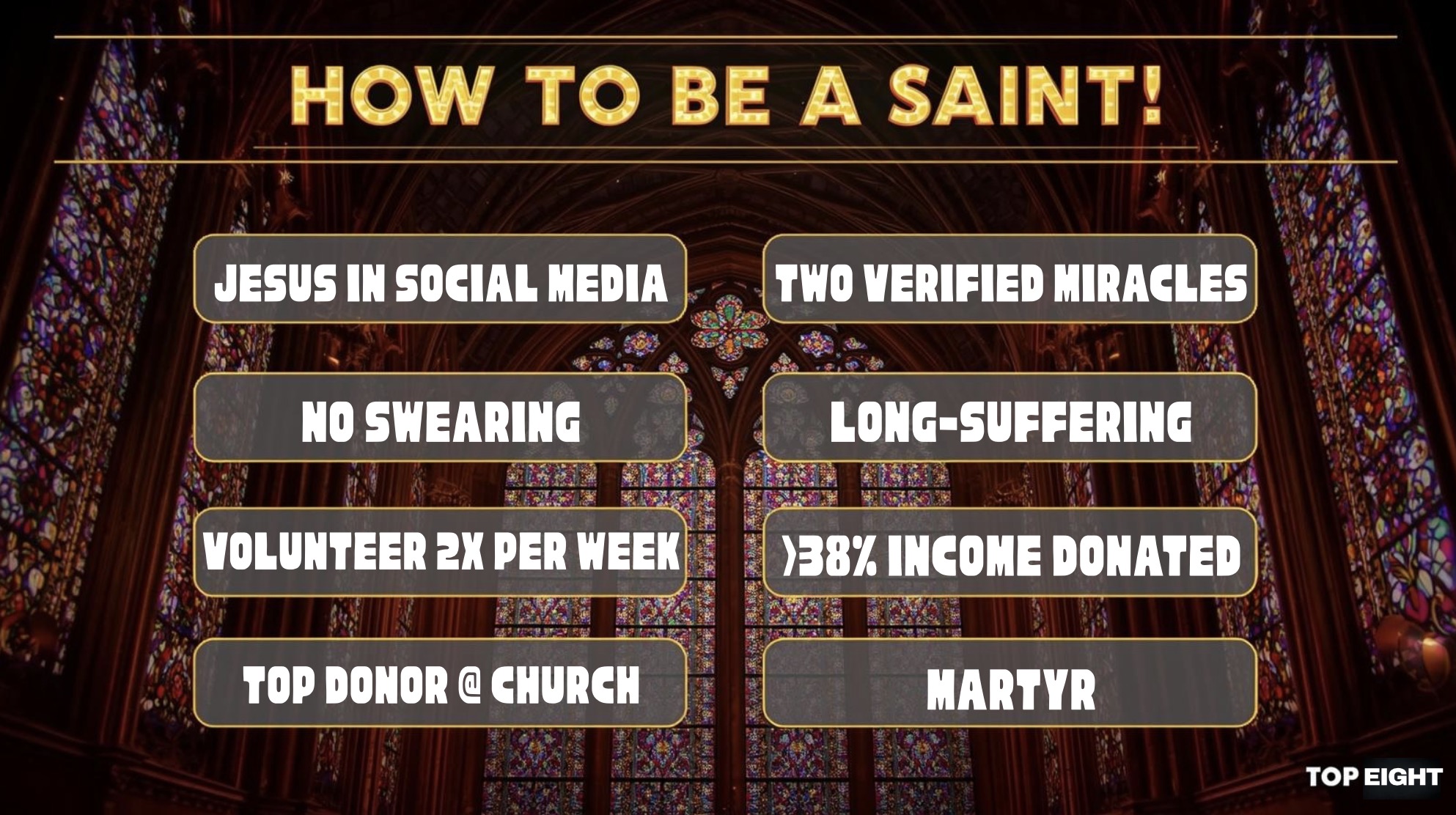
Number 8: Mention Jesus in at least a quarter of your social media posts. Note that “faith” is not enough – be specific about Jesus.
Number 7: Never swear or cut someone off in traffic.
Number 6: Volunteer at least twice a week, preferably at church.
Number 5: Give enough money to the church to be the top donor for the year. Bonus points for including the church in your will.
Number 4: Be credited with at least two verifiable miracles after your death.
Number 3: Suffer for a long time and with good cheer.
Number 2: Give at least 38% of your income away.
And the number one way to be considered a saint is…be martyred. Die for the faith. Going out in a blaze of glory means you can skip a bunch of the other stuff right?
So, who qualifies as a saint? Those are obviously not the real qualifications, but there’s this idea out there that saint means some kind of super-Christian, someone who has it all figured out, who’s given everything away and spent their entire life just focusing on God.
We treat it like a Medal of Honor award, or something. (And please don’t expect anything in that list from our new office administrator.)
And I know that list is snarky, but I don’t want to diminish the people the church honors as saints. I think it’s important to remember the stories of our ancestors in faith and the ways God has worked in and through them. We need role models to follow.
We Lutherans could learn something from the ways our Roman Catholic siblings honor God’s work in the lives of particular saints.
But when the Biblical writers speak of saints, they’re referring to the whole community of believers. I’ll repeat what I say every year on All Saints Day: Every Christian—every follower of Jesus—is a saint. The label of saint applies to everyone who believes in Jesus.
We are children of God not because of anything we do—not because we give 38% or more of our income away, not because we volunteer enough or don’t complain when we’re suffering—we are children of God because of what God has done for us.
We talked a bit last week on Reformation Day about Martin Luther; well, one of Luther’s great insights was that each of us is both sinner and saint at the same time. If you put together a top 10 list of Lutheran beliefs, I’d say this is in at least the top five.
We are simultaneously sinner and saint. We sin, we mess up, we do the wrong thing and fail to do the right thing, and yet, because of God’s grace, we are also saints. We are washed clean in the waters of baptism, we are claimed by God, forgiven and set free. God makes saints out of sinners.
Here’s a more Lutheran top eight list of how to be a saint:
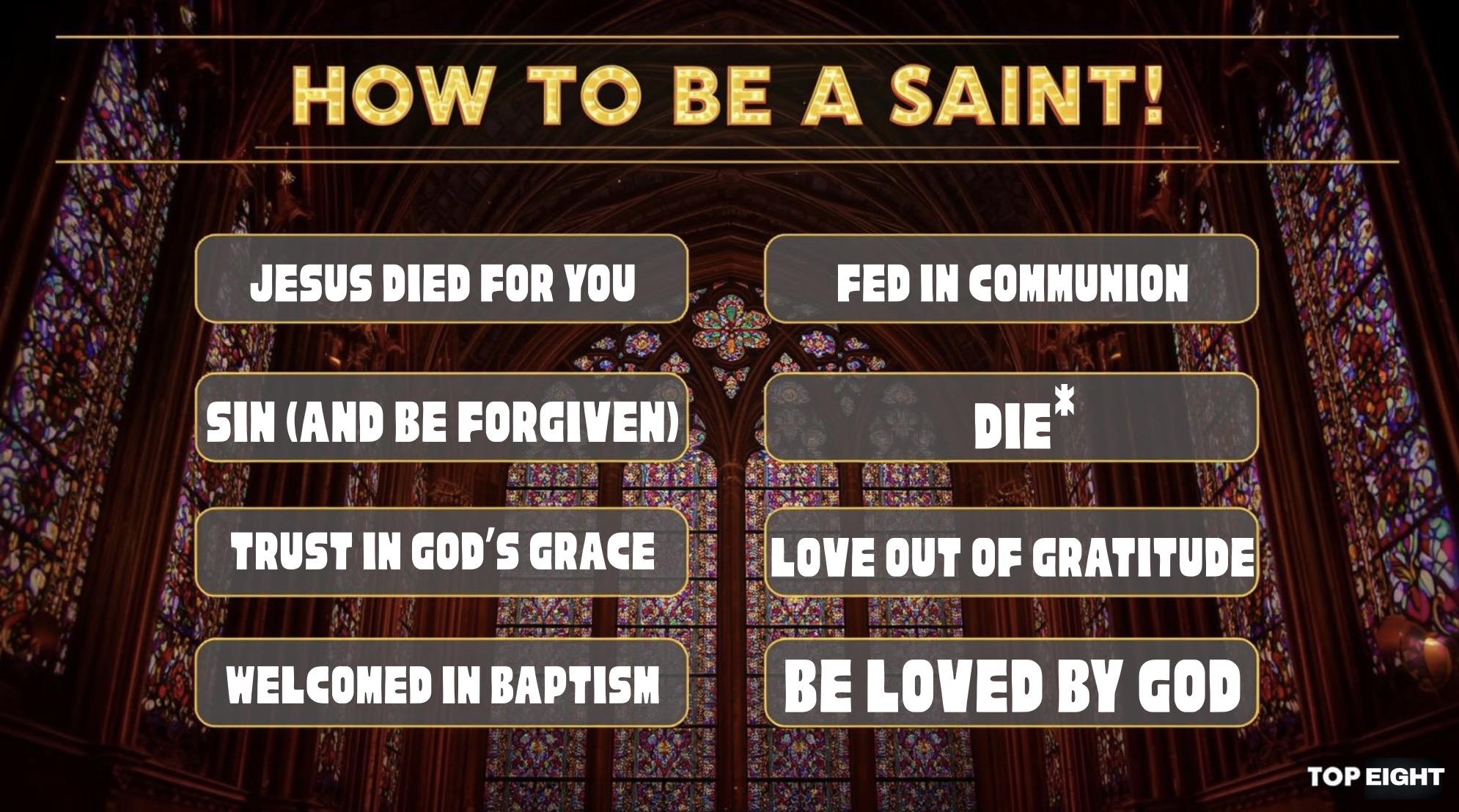
Number 8: Be someone for whom Jesus died.
Number 7: Sin (and be forgiven).
Number 6: Give up the quest for heaven and trust in God’s grace.
Number 5: Be welcomed into God’s family in baptism.
Number 4: Be nourished for the journey by receiving Holy Communion.
Number 3: Die at some point, because saints are honored on their death day. (There’s an asterisk to that one – being alive when Jesus comes in glory is also an option.)
Number 2: Love your neighbor out of gratitude for the love God’s given you.
And the number one way to be a saint is…be loved by God.
This church is a community of people who are loved by God. That’s our identity. This is a communion of saints.
I want to turn to our readings, and I want to echo this morning Paul’s words to the Ephesians. He writes, “I have heard of your faith in the Lord Jesus and your love toward all the saints, and for this reason I do not cease to give thanks for you as I remember you in my prayers.”
I’ve spent a lot of time this week reflecting on who we are as churches, both Christ the King and Living Hope.
In every job interview at Christ the King, I’ve tried to summarize who we are as a community, as a church, how there aren’t very many of us, but how we punch above our weight, how we do things like Stone Soup for food pantries and make quilts, how we’re committed to welcoming all people.
At Living Hope, a good group of people spent yesterday morning having conversations about our mission, how we got here and where God is calling us to go, and again, how important it is to us as a church to be making a difference in the community around us, how we’re proclaiming a message of God’s love for everyone, and how important that message is in today’s world.
I’m grateful for the saints of this congregation, and again, that includes all of us. I’m grateful for the saints who’ve come before us, who have dedicated so much of their lives to this church, not for ourselves, but so this can be a beacon of God’s love for our neighbors.
I’m grateful for the saints we remember today—the ones we’ll name aloud a little later, and the ones each of us privately remember—the people who have shaped our faith, who have told us about God’s love and invited us to trust in Jesus, who have taught us to love our neighbors, to care about our communities.
I know there’s grief today in that remembering, but our grief is shaped by gratitude, and by the promise of resurrection, the promise God’s claim on each saint lasts for eternity.
On a wider level, I’m grateful to be in a flavor of Christianity committed to living out what Jesus talks about in the sermon we hear in Luke 6.
Listen to what Jesus says love looks like in action: “I say to you who are listening: Love your enemies; do good to those who hate you; bless those who curse you; pray for those who mistreat you…Do to others as you would have them do to you.”
Some of the loudest Christian voices in our society seem to have a hard time with those teachings, let alone the part before it about woe to the rich, blessed are the poor, and all that.
It’s a lot easier to turn faith into debates about who’s in and who’s out, or what kind of people count as “real Christians” or to judging how other people should live. Living and loving in the way of Jesus is more difficult.
And I’m not saying we’re perfect. Again, sinner and saint at the same time. We have a long way to go. Each one of us—myself included—creates plenty of opportunities to repent and receive God’s forgiveness.
Loving your enemies is hard! Doing good to those who hate you rather than seeking revenge—that’s hard! But I’m grateful we’re a church committed to trying to do to others as you would have them do to you.
That means we believe everyone deserves food. We believe everyone is welcome at Jesus’ table. We believe God’s grace sets us free not to sin more, but to forgive more.
We believe blessings are given to us to share with others. We believe sinful people like us can also be saints, because God’s love covers a multitude of sins. I’m glad we’re here to share that version of Christianity.
As we remember and give thanks for the saints who have gone before us, I pray we will continue to proclaim the truth of God’s love for all the saints.
I pray the Holy Spirit will continue to bind us together as a Christian community, and call us into action bearing each others’ burdens, offering good news to our neighbors both by what we say and by what we do, sharing the living hope we have in Jesus Christ.
I pray we’ll be moved into action, following the example of the saints who have gone before us, relying on the grace and love of Jesus, inspired by the Holy Spirit.
And I’m grateful for God’s grace in claiming us sinners as saints, for Jesus’ sake. Amen