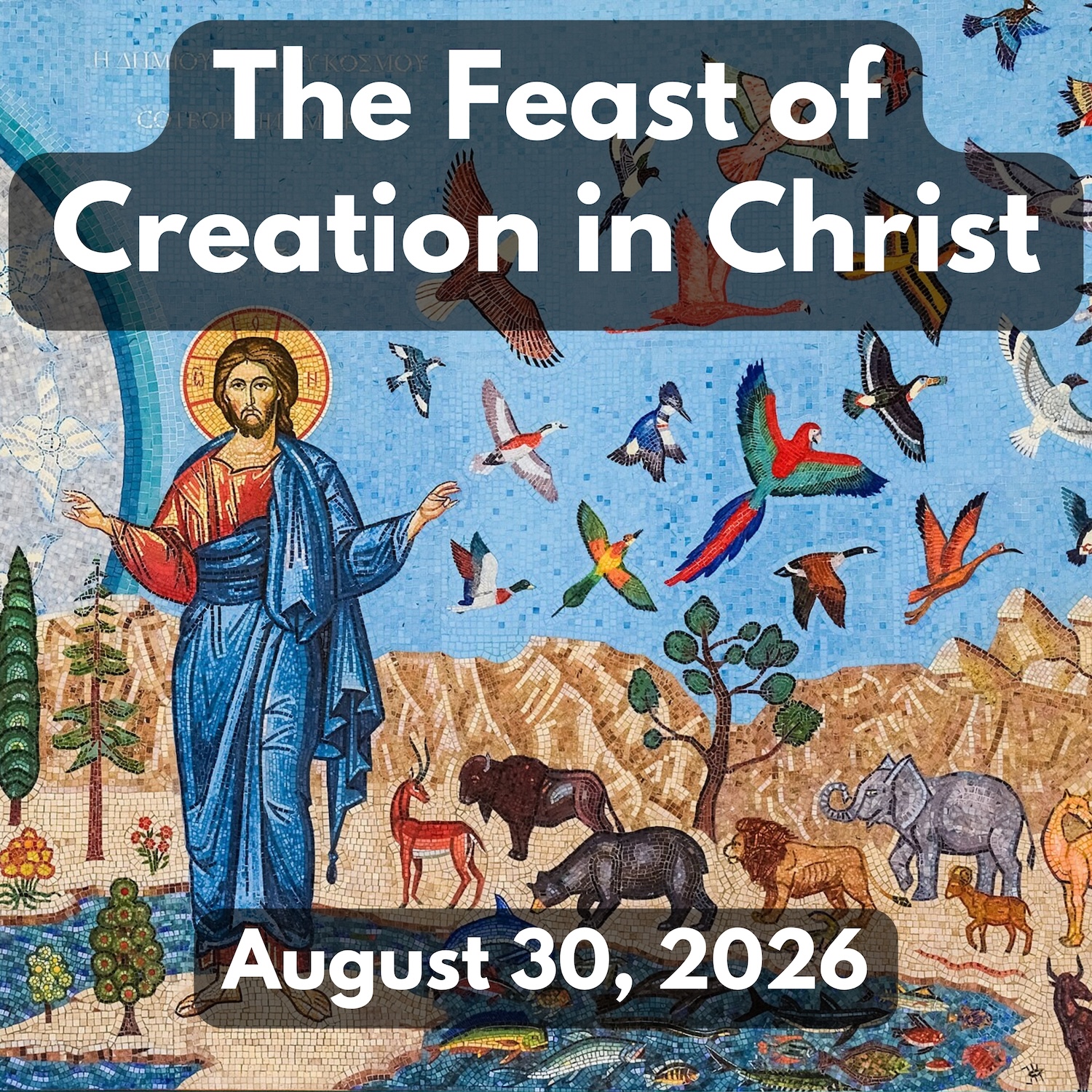
 Today in worship, we celebrated a new church festival day: “The Feast of Creation in Christ.” (Visit https://www.feastofcreation.com/ to learn more.) In addition to exploring what it means to praise God as Creator and ponder the great mystery that everything was created through Christ, this sermon reflects on this new festival as ecumenical progress towards Jesus’ prayer that all his followers would be united.
The first Scripture reading from Genesis 1:1-2:4 is read in The Message version. Other Scriptures included in the service are Psalm 148; Acts 17:22a, 24-28; and John 1:1-5. Much of this sermon was inspired by Steve Thorngate’s interview with Kimberly Belcher and informed by Frank Senn’s lectionary reflection, both published in The Christian Century. The ELCA’s resource for this new feast day was also helpful.
Here’s the livestream from Living Hope and the sermon podcast audio.
Powered by RedCircle
Grace to you and peace from God our Creator. Amen
As I mentioned before, today we are marking the “Feast of Creation in Christ” and I’m going to talk about the readings we heard and the theme of creation. But before we get there, I want to read a few verses from Jesus’ prayer at the last supper in John 17.
Praying for his followers, Jesus asks, “that they may become completely one, so that the world may know that you have sent me and have loved them even as you have loved me.” Jesus prayed for his followers to be united, that the Church would be the body of Christ together.
Sometimes, that unity can seem very far off. I did a funeral on Friday for someone connected to a church of a different denomination, a different flavor of Lutheranism, and the church whose cemetery it is had to have a pastor of their denomination do the burial, even though I could do the funeral, as long as it was at the funeral home.
I’ve heard stories from some of you of being turned away from communion because you weren’t the right kind of Christian.
One reason I’m a committed ELCA Lutheran is because we don’t believe we have a monopoly on how to worship God the right way. We’re committed to working ecumenically between churches, cooperating together as the Body of Christ. We’re still very far from being “completely one”—and I should acknowledge that we Lutherans are the result of church division 500 years ago—but things like last week’s Lighthouse service at the United Methodist Church give me hope. Wasn’t it beautiful to have four churches of three denominations worshiping together?
This Sunday’s another example of what I’ll call ecumenical progress as we celebrate this “Feast of Creation in Christ” for the first time. I’d say it’s much easier to add a federal holiday to the United States calendar than to add a festival to the church calendar and get a bunch of different churches and denominations to agree.
But this spring, the Consultation on Common Texts officially added the Feast of Creation in Christ to the Revised Common Lectionary on September 1. Take a look at this video.
Yes, I realize technically, we’re celebrating either a day or a week early. I’m on vacation next Sunday and I didn’t think you’d all come back tomorrow.
That video is from the World Council of Churches, which represents some 580 million Christians from more than 120 countries. The Orthodox Church started this invitation in 1989, and now in 2026, this festival is also commended for celebration by the Lutheran World Federation, Baptist World Alliance, the Roman Catholic Church (there’s one and a quarter billion people right there), the World Evangelical Alliance, and even groups like the Salvation Army and Unitarians.
As Catholic liturgical theologian Kimberly Belcher says, “This is the first time in history that Christians have tried to adopt a feast ecumenically.” I think that’s something worth celebrating.
This festival invites us to reflect on the mystery of creation in Christ. What does it mean that God is the Creator?
On one level, this is an obvious thing we can cooperate on, because all Christians agree God is creator. We disagree on a lot, but it’s pretty clear when you read Scripture—the first story is God creating.
And then on a deeper level, this image, this story, this mystery of God creating all things, God forming the cosmos, shapes everything that follows.
The reason sin is a problem, the reason we repent and need forgiveness, is because we fail to follow the directions of our Creator. We try to take the Creator’s place, go our own way, but we are part of the creation. God the Creator gets to set the rules. God’s authority starts because God is Creator, and God makes a good creation.
The entire story of the Bible is God working to restore a fractured world to what it was created to be, working to repair what has been broken, restoring our relationship with God, moving us toward unity with each other and our neighbors and harmony with all creation.
We see creation’s power in disasters like this week’s landslide in Nepal; we see creation’s brokenness in the violence of floods and earthquakes.
And yet the goodness of creation, the beauty of a sunset, the diversity of millions of different kinds of insects, the heights of the mountains and the depths of the seas, the vastness of galaxies and the intricacies of cells all reveal the goodness and beauty of the Creator.
There is more to the cosmos than our little human brains can possibly grasp or understand, but we know God has declared it good. Over and over, God declares creation is good. And we are part of God’s good creation. You are part of God’s good creation.
This festival invites us to respond to God’s creative work in two ways. First, we are to give thanks, to marvel at what God has done. That command is all over Scripture.
It’s in the Psalm we read: We join with all creation in giving praise to God. Praise the Lord, sun and moon, sing praise, all you shining stars. Praise the Lord from the earth, you sea monsters and all deeps…mountains and all hills, fruit trees and all cedars, beasts, cattle, birds, all creation gives praise to God.
We are called to join the hymn of all creation, to join in praising the One who made us and the world and the cosmos, the One through whom life and light came into being.
We gather every week to praise God. Sometimes I think we lose sight of that a bit. We come together to be fed and renewed, to learn about God through Scripture and sermons, we pray, and all of that’s important, but it’s called worship. We are here this morning to praise God.
We’re here to worship, because God our creator and redeemer deserves our worship, our song, our praise, everything we have to give. Praise the Lord!
And the second way we respond to God’s creative work—one of the ways our praise takes shape—is to care for creation, to tend God’s garden. Our call—the very first command in Scripture, right there in the first chapters of Genesis—is to “Be fruitful and multiply and fill the earth and subdue it and have dominion over the fish of the sea and over the birds of the air and over every living thing that moves upon the earth.” We are stewards, entrusted with caring for creation, working towards the shalom, the wholeness God intends.
Part of the impetus behind this new festival happening now is that creation is in pain. We as humans take for granted that we have enough air and water, and we treat the resources of God’s good creation as something to exploit. But we are stewards. We are caretakers.
The World Council of Churches points out that last month was the warmest July on record.
The WCC General Secretary says, “In a time in which the destructive consequences of human-made global warming become increasingly apparent and cause much suffering, praying to God and doing justice to human beings as well as to the earth is inseparable…
Many of our member churches are among the communities already living this crisis, in drought and flood. For them, prayer and action are not two callings but one: the churches are called to become part of the river’s healing, not to stand at the bank and watch.”
How do we care for the creation God entrusts to us? How do we unite as the Body of Christ to care for our neighbors in need, to tend to creation?
And how do we keep the faith that we’re not alone in this work, that God has not set up creation and then abandoned it? Rather, God is still at work creating.
God is still at work forgiving, restoring, renewing. “In him we live and move and have our being…for we, too, are his offspring.” This is our hope, a weary world reconciled, creation at peace.
Paul writes in Romans 8, the whole creation waiting with eager longing to be set free by God, redeemed by its Creator. In Colossians 1, he says through Christ, God is reconciling all things to himself. Making us more like Jesus.
God is restoring all creation. God is at work—the same One who creates also redeems. We give thanks for God’s good work of creation. And we give thanks that the God who creates the cosmos creates you and me. The God who sustains all things sustains us.
Praise the Lord!
Pingback:Villains in the Bible: The Serpent | September 20, 2026 - Pastor Daniel Flucke