 After a wonderful week away on a family vacation to Sesame Place Philadelphia, Hershey Park, and the seaside in New Jersey, it was good to be back home to lead worship this week (back in the church buildings!).
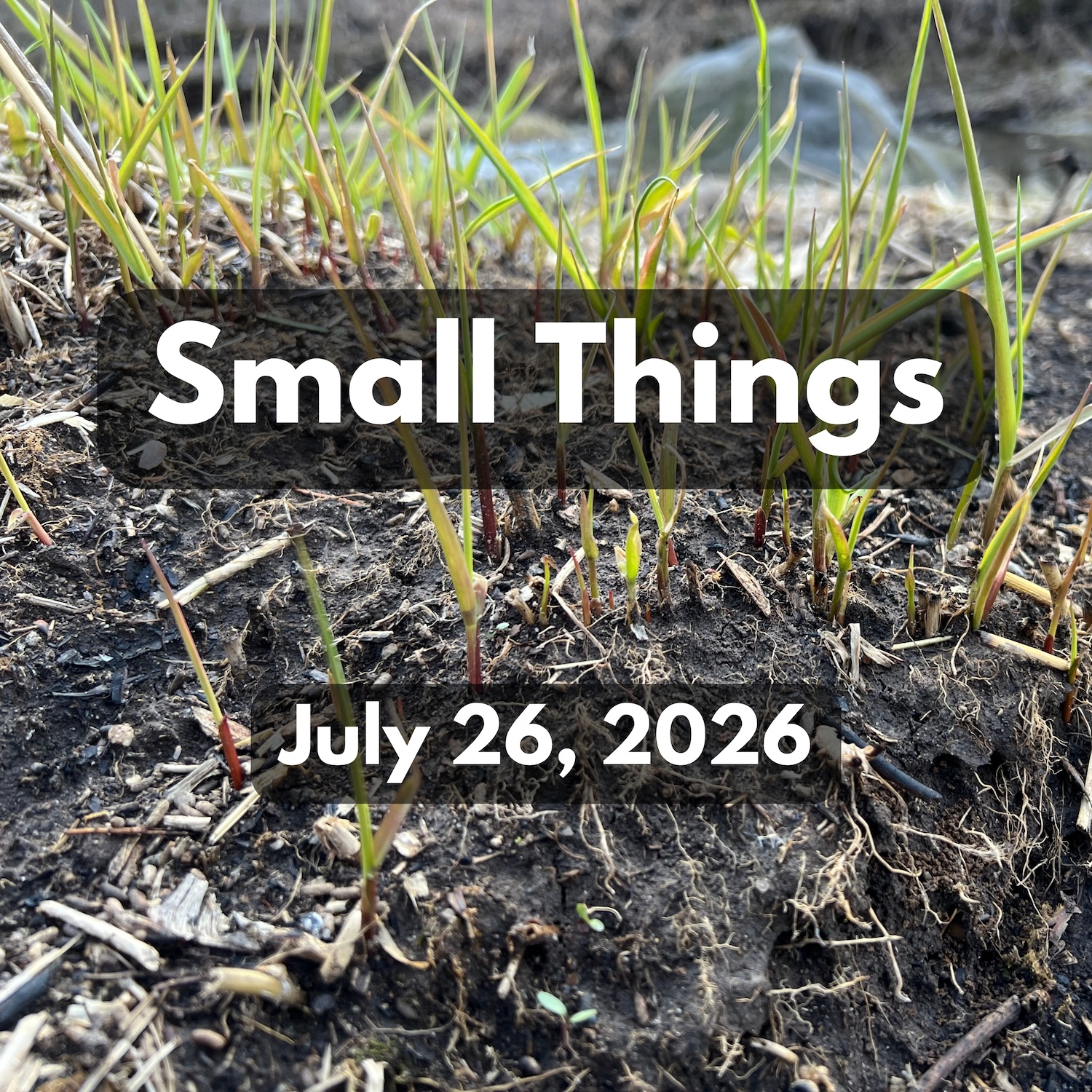
A loose theme throughout this summer is the phrase “Do Something” and the idea that none of can do everything to build God’s kingdom, but each of us can do something. This theme continues this week in Matthew 13 as within just a few verses, Jesus tells not one, not two, but five parables about the kingdom of heaven. God can work through our small actions to make an eternal impact.
This week’s Scripture readings are Romans 8:26-39, Psalm 119:129-136, and Matthew 13:31-33, 44-52. I found helpful for this week Zina Jacque’s 2026 commentary on the Gospel passage at Working Preacher as well as Deacon Timothy Siburg’s sermon from last week.
Here’s the livestream from Living Hope and the sermon podcast audio:
Powered by RedCircle
Grace to you and peace from God our Father and the Lord Jesus Christ. Amen
Before I get into today’s readings, I want to say thank you to Fred and Ralph, and of course everyone else who helped lead worship last week while I was on vacation. We had a wonderful family road trip to Pennsylvania and we even made it to the ocean in New Jersey.
And by the way, it’s a very long drive from here to the ocean. Our boys did great, but I’m still recovering a bit from vacation. Did I mention it’s a long drive?
We’ll get to today’s gospel reading, but first I want to go back for a moment to Jesus’ parable about the sower spreading seed in good and bad soil. I know if you were here last week you heard more of Jesus talking about seeds and separating wheat from weeds, but I want to go back to the beginning of Matthew 13.
I won’t read it all, but the short version is Jesus tells a story about a sower who went out to sow and cast seeds all over the place.
Some seeds fall on the path, and the birds eat them up. Some fall on rocky ground, and they spring up quickly, but fail to grow roots. Others fall among the thorns and are choked out, and still others fall on good soil and produce grain; they bear good fruit and multiply.
I talked about two perspectives in this story: We are called to be good soil, to allow God’s word to take root in our hearts and grow so we bear good fruit. And we’re also called to be like the sower, generously scattering the good news of God’s kingdom everywhere, even in places where we might not think it’ll grow.
Well, this week I read a sermon from Deacon Timothy Siburg from the Nebraska Synod, and he pointed out a third perspective. What if in this story, you and I are also the seed?
What if part of what Jesus is saying is that God has planted us, scattered us here to grow? Sometimes we find ourselves in fertile soil. Life is good. It’s easy to do good, easy to grow and bear fruit.
Other times, we find ourselves in a tough season, out on the hard ground, longing for some refreshing water or stuck in the shade straining to reach the light. Maybe even surrounded by some pretty tough weeds. Fred talked about that last week.
But as Deacon Siburg points out, “if you and I are the seed that God is planting, then it is God too who gives us life, is it not?…You are filled with God’s life-giving breath. You are created in God’s own image…God is doing the hard work of bringing life out of death…We are called to grow. To be curious. To Learn. To care for one another.”
I like that idea of God planting us as seeds as we hear the parables Jesus tells in today’s gospel, a little later in that same chapter, Matthew 13.
Did you notice, by the way, there are five separate parables, five separate images in these 10 verses? Jesus really wants to get our attention, so he comes at the kingdom of heaven from five different angles.
Jesus is talking to a mixed crowd of people, fishermen, farmers, people who know their way around a kitchen, people more comfortable in the marketplace, so he uses all these different images to speak to everyone in his audience. Maybe some of these images make sense to you; maybe some don’t. That’s part of the beauty of parables.
Before I get to the actual images, I have to point out what I think is one of the most frustrating verses in the Bible. You know how when you read the Bible over and over, you notice new things? God shows you new things as you spend time in God’s word? I don’t recall ever noticing this verse before.
Matthew 13:51—it’s short. Jesus is talking to his disciples, his closest friends, and after telling them a bunch of parables, he asks them: “Have you understood all this?” They answered, “Yes.”
Isn’t that irritating? Do you understand everything Jesus is saying in these parables? I certainly don’t. I’m pretty sure the disciples don’t get it all either. But they’re willing to keep following Jesus.
Jesus describes the kingdom of heaven as a tiny mustard seed which grows into a tree where birds can come and find shelter. The kingdom of heaven is like a little bit of yeast that leavens all the bread. It’s treasure hidden in a field, a pearl of great value, a net catching fish of every kind.
I’m not so bold as to say this is Jesus’ whole point with all these parables, because parables always have multiple layers of meaning, but at least one of the themes I get from several of these is that God works through what the world overlooks. Small things can have a big impact.
And of course, that fits really well with our “Do Something” theme for this summer. The point we’re trying to make with this theme is that the world is a big place, and there’s a lot of brokenness in it. There’s a lot of need, a lot of suffering, and it’s easy to get overwhelmed.
None of us can fix everything. None of us can do everything. But we can all do something. And God can make a difference through whatever we have to offer, whatever we can do. We love our neighbors one act of love at a time, one meal at a time, one conversation, one smile at a time. God works in the little things. The unimpressive. Ordinary life.
Jesus says, “The kingdom of heaven is like yeast”—a single-celled microorganism. I looked it up—a single yeast cell is something like 2 to 8 micrometers. That’s pretty tiny. Invisible to the naked eye. Can’t do much.—
“The kingdom of heaven is like yeast that a woman”—and note that Jesus in this story centers a woman cooking. Not someone seen as a heroic figure in that culture. But she’s doing God’s work, mixing in the yeast.—“The kingdom of heaven is like yeast that a woman took and mixed in with three measures of flour until all of it was leavened.”
The Greek word translated as “mixed in” can also mean “hidden” or “concealed in.” The yeast is so small that it’s hidden in the flour. And it’s a lot of flour. Each of those “three measures” of flour is about 16 pounds, so this is nearly 50 pounds of flour, “enough to feed over a hundred people.” (see NET Bible footnote 52 on Matthew 13:33).
But that little bit of yeast—billions of tiny cells working together, each doing their small part—is enough to leaven all the flour, to change it from flour to bread.
A tiny mustard seed can grow into a great plant, a tree big enough for birds to come and nest in its branches. God works with small things, things that appear almost insignificant, and uses them to change the world.
We might not see the results of our actions. It takes time for the seed to grow, even for the bread to rise. God’s kingdom is like a treasure hidden in a field, beneath the surface, easily overlooked. But when that treasure is found, it’s worth selling everything you have just to possess it.
It’s not one of Jesus’ parables, but one of the images I think of is the waves in the ocean. I learned last week that Micah loves standing in the ocean, feeling the waves hit, the waves blowing into the shore, over and over.
The weather was good when we were at the beach, so the waves were pretty small (that’s as big as they got). Not a hurricane, not a tsunami, not even really a tide, just wave after wave after wave. None of the waves were very strong. But together, if you wait long enough, the waves break down rocks into sand.
Or a few weeks ago on our way back from the Lighthouse trip to Nashville, we stopped at a cave in Kentucky.
Limestone stalactites form from the minerals in dripping water at a rate of roughly 10 centimeters every thousand years. A single drip doesn’t seem to do a thing. But over time, together, they add up to something beautiful.
God’s kingdom grows often almost unnoticed. God’s timing is rarely our timing. But God can work for good through even our smallest acts of love. Even if our little church sometimes seems insignificant. Even if I can’t make a dent in world hunger, or end human trafficking, or build enough homes for everyone.
We can’t do everything; we don’t know everything. Sometimes, we don’t even know how to pray as we ought. But as Paul promises, “The Spirit helps us in our weakness.”
Our task as followers of Jesus is to trust God is at work, and to love faithfully, to live faithfully as the Holy Spirit leads us. Even without understanding everything, we trust the one who has planted us, who gives us life, and who continues to work through us.
We pray with the Psalmist “Keep my steps steady according to your promise.” We trust God to bring good out of even the most hopeless situations.
And we proclaim the good news of the gospel, the good news that there is nothing, neither death nor life, nor angels, nor rulers, nor things present, nor things to come, nor powers, nor height, nor depth, nor anything else in all creation that is able to separate us from the love of God in Christ Jesus our Lord. Thanks be to God.
Amen
Pingback:Included and Fed | August 2, 2026 - Pastor Daniel Flucke